

Finally getting to Hudson Bay was a big milestone in my life. It has taken me a week to place the experience in its proper slot. A little perspective was needed, as the two week period I spent on the Hayes River was extreme in every sense of the word.
The trip I lined up was different from any other canoe trip I’ve taken in that I was not in charge. That turned out not to be a problem at all. My two guides were extremely competent and well-organized, and I felt very safe with them. There were eight people in our group, including the guides: four men and four women, ranging in age from 31 to 75, in four canoes. Because of the wildfires, we had to change the original route slightly. That meant we had to fly into 50-mile-long Knee Lake and land at a private airstrip used primarily by rich Americans to access a swanky fishing camp. The flight itself was a little harrowing because of the wildfire smoke in the air. Half of the flight we were unable to see the ground. Because it was a visual flight rules only plane, meaning no radar, the visual part was hit-and-miss. After both our flights arrived at the lodge, paddled for about an hour before making camp.
The first two full days of paddling were care-free: sunny and pleasant weather, little wind, relatively few miles, and flat water. We switched pedaling partners every day so we got to know everybody in the group. In the mornings we awoke to ash covering our tents. On the third day the wind picked up and the smoke dissipated. We fought heavy waves all day, but we finally reached the end of Knee Lake. Then the fun began. The Hayes River features 55 sets of rapids, most of them one after another with no rest in between. When I saw the first set of rapids, I thought to myself, ” I don’t think I can do this!” But that turned out to be one of the few rapids that we portaged. Thank goodness! We followed that set with about 10 more before the day was finished.
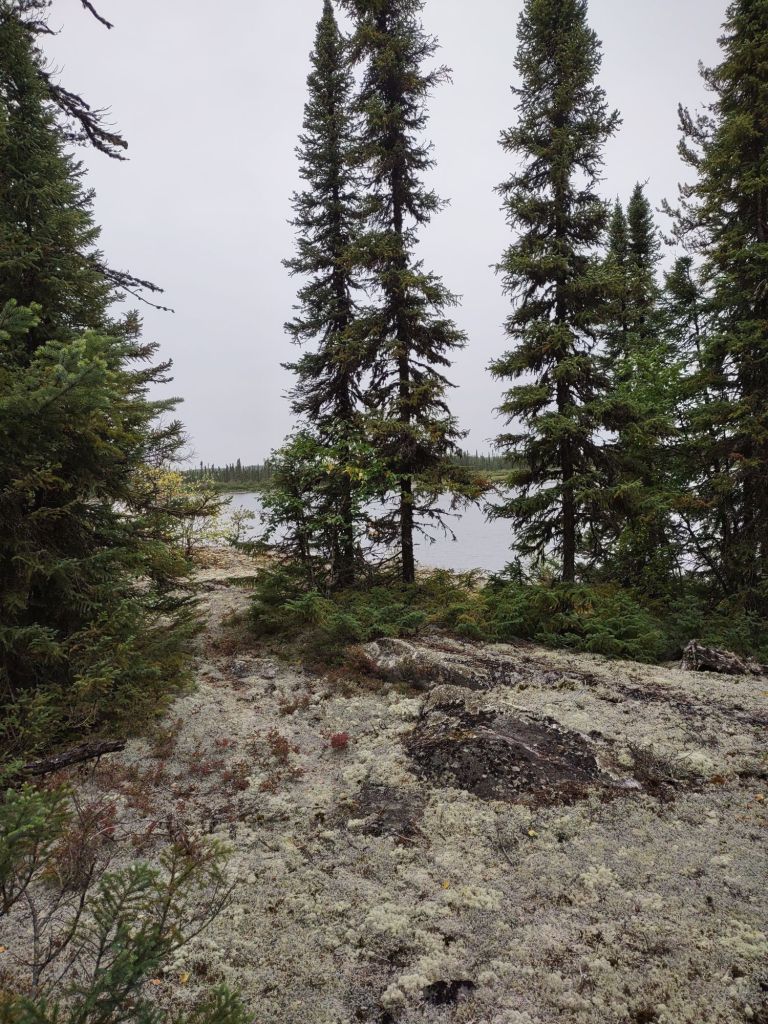
The next day we had another long lake (Swampy Lake), but this time we fought head winds the whole time. That night we had a lovely and expansive campsite. Because we had eight tents for eight people, we had to have lots of room. Often we were high up on a rocky knoll with reindeer lichen and elegant sunburst lichen six inches thick. A view of the lake from above, zillions of blueberries and lowbush cranberries, and great swimming rocks completed the picture. We had fresh fish on nights two and three.
Soon the stretches of continuous rapids began. It required constant attention, as the current was quite powerful even though the water was shallow. After Swampy Lake, we never again had a relaxing evening. The water level on the Hayes River was very low. Consequently, we ran into shoals and gravel bars constantly, requiring us to either get out and walk the canoes, or backpaddle. Either way, it was time-consuming and we got to camp later and later at the end of each day. Add to that the fact that the sun never shined again. It rained everyday, and the mosquitoes began to swarm as the sun got lower in the sky. Put it all together and you can see why we all retired to our tents immediately after eating supper. No campfires, no sitting around yucking it up, very little singing.
We spotted a black bear with a cub, and later another sow with two cubs. We also enjoyed some curious otters, saw sandhill cranes and listened to their croaky cries, and were watched over by countless bald eagles and hawks. Loons, ducks, geese, swans, seagulls, and pelicans were a constant. Special sightings were of a lynx, a caribou, and a wolverine.
The low point of the trip for me was on Day 6. I was paired in the canoe that day with a 75-year-old man. We both thought we knew what we were doing, and we both thought we knew better than the other. The problem is that we didn’t think alike. No matter where we sat, stern or bow, we were at odds with each other. The inevitable result was that we swamped in a rapids because of us each trying to go in a different direction. That wasn’t so terrible in itself, except that it was a very cold and windy day and we both began to freeze. Luckily we each had some dry clothes. We had to strip right there on the rocks and put them on. That capsize episode set us back probably an hour, so we got to camp late. I set up my tent in the rain and was fine until I pulled out my sleeping bag and it was sopping wet. The dry bag protecting it had not done its job. My partner’s gear was also wet. When people started offering me their extra clothes and rain jackets and emergency blankets and dry socks, I lost it. It is always sympathy that makes me cry. So I had a public episode. But I got through the cold night, and everything dried eventually. I used my jetboil to heat water to keep my feet warm, and I had to get up in the night several times to reheat my water because I was so cold. In retrospect, except for the swamping, it was a really great day. We had lots and lots of rapids that we just cruised through. Each time you get to the bottom of a rapids you are ecstatic because you made it! There was a lot of ecstasy this day. We camped just below Kakwa Falls.
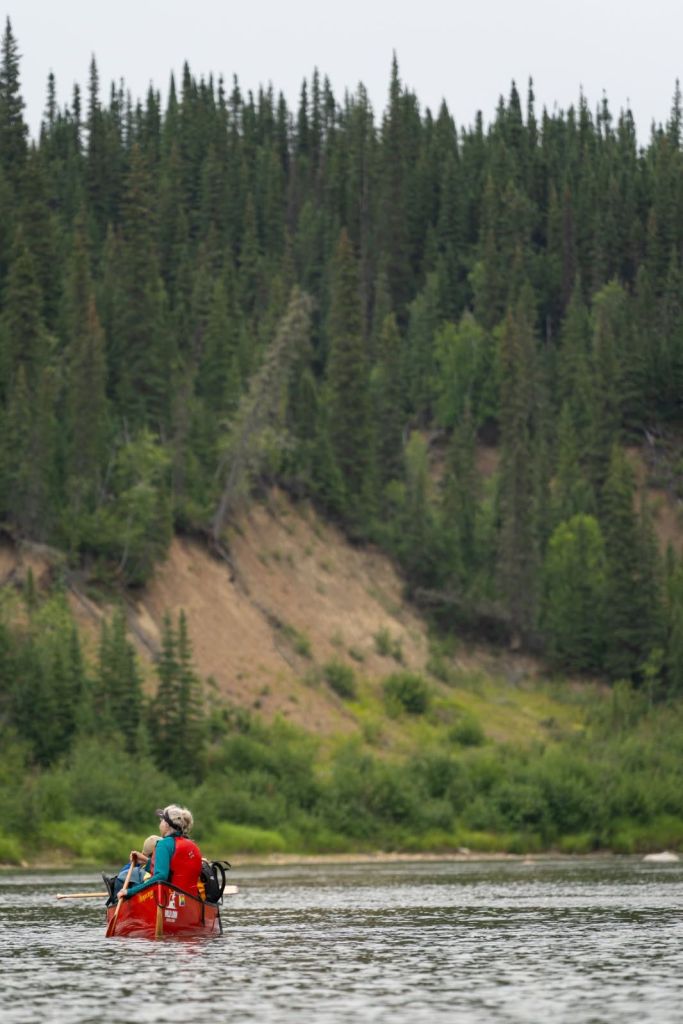
The next day was more of the same–continuous rapids– except that nobody swamped. Our guide told me he has never taken people in their 70s on a canoe trip, and this time he had three of them. He said his friends will never believe that three 70+-year-olds paddled the Hayes River successfully. That made me feel good. And it also made me feel competent when I was assigned to the stern of the canoe every day. That position requires ability over strength, and at this point that is what I have. That evening we reached White Mud Falls, which is the last impediment to a free-flowing river. It is called White Mud because of all the clay and sand eroding down the banks of the eskers through which we were passing. The eskers are glacial deposits of sand that collected under a glacier. This whole river is flanked by high esker cliffs, which are slowly eroding down into the river. They tower over the river so much that it seemed we were paddling through the Grand Canyon. They are spectacular and incredible. And they go on and on, sliding into the river. It is a totally different topography than I have ever experienced.
The next day the smoke returned, the wind was strong, and it rained all day. We kept getting stuck on gravel bars. There was a lot of maneuvering necessary to stay in the proper channel. These shallow areas were interspersed with rapids so we had to pay attention all the time. People were beginning to get tired after a week of constant paddling with little down time. My shoulders felt like they weren’t even attached to my body anymore. It’s like I had free floating joints. I borrowed painkillers from all my friends. We spotted three moose making their way across the river ahead of us, shambling through the shallows.
Day 9 was very difficult. We had a 45 km headwind all day and we had to paddle over 50 km. It was raining most of the day and we were all freezing. Stopping for lunch was very unappealing because there was no shelter from the wind. So we jumped around on the rocks a little until we were so frozen we had to get back in the boats to paddle to get warm. We didn’t make our goal this day, so we were behind. It had become very clear to me that Deb, Deb, and I (our original trio) would not have been successful on this river. It is impossible for me to navigate rapids by myself, and they would have been of little help, with one being blind and one having slow reactions. So in the long run, I am happy it turned out this way, because at least I finished the river.
Day 10 was even more difficult. The eskers had begun moving back from the river in preparation for the estuary. That made it easier for the winds to reach us. The headwinds were over 60 kilometers per hour and we ended the day about 20 km short of where we needed to be in order to reach our destination of York Factory on time We camped on a wet and sloping cobblestone sandbar and the mosquitoes were ferocious. Because of the wind and the cold, none of us had been able to swim or bathe or even dip a toe in the water for 8 days. Things were getting very ripe. Our guide fired off his gun for the first time, both to make sure it was in working order and to scare away any marauding polar bears. We hadn’t seen any, but we were definitely within range of their territory. We even had to put our tents in a line so as not to appeal to or threaten the bears.
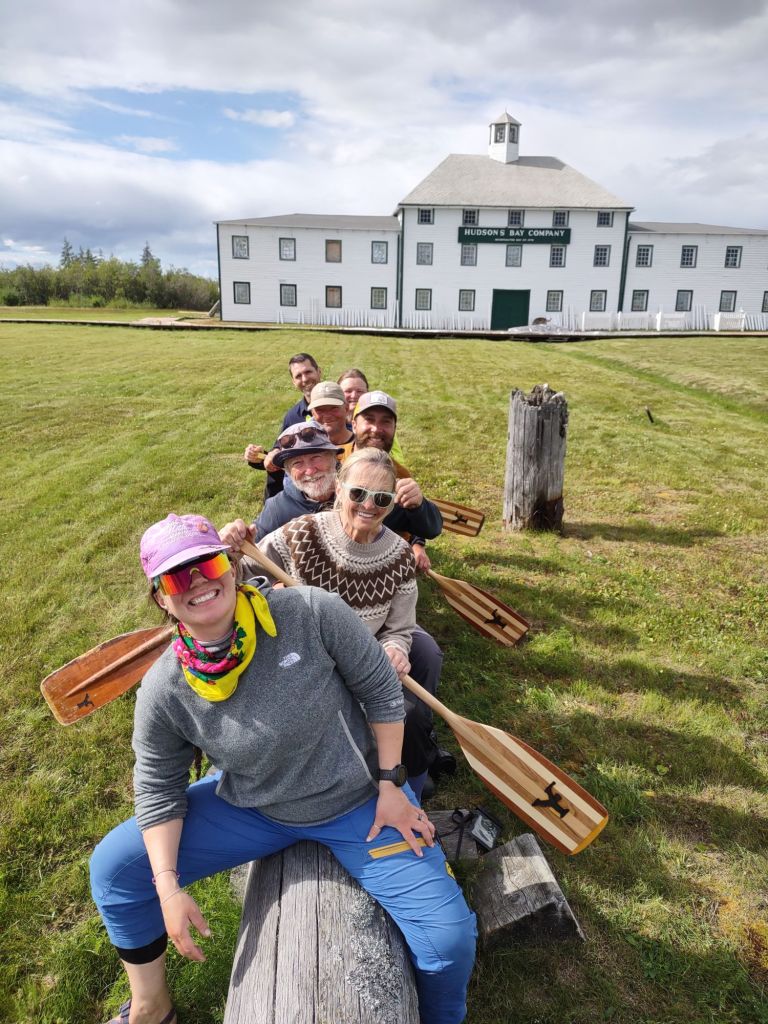
Day 11 — I can’t even begin to describe this day. It rained hard all day long. The wind was coming in from the bay at 97 km per hour, resulting in big waves for us to paddle through. We had timed our arrival at the estuary to coincide with the high tide so that the receding water could help us with our paddling. So we had the current and the tides going our way, but the wind and the waves going against us. Once again we were all freezing but there was no way to stop and get out of the canoes because of the threat of polar bears. We got kind of strung out along the river even though our intentions had been to stick close together. The estuary seemed to go on forever, probably because we were paddling twice as many strokes to cover half the distance. Some seals poked their heads up to look at us as we slowly passed. By the time the York Factory building appeared on the cliff, we were all nearly hypothermic. Even unloading the canoes was problematic because of the waves and the wind and the bouncing dock. Like a vision, a bunch of angels in the guise of young men appeared to help us carry all our gear and canoes up the 60 steps to safety. They ushered us into a warm building where we would spend the night, brought us water and blankets, and invited us to their building (The House) for supper. We were all so exhausted and so cold that we could hardly appreciate the kindness and generosity they bestowed upon us: hamburgers, pork chops, fried potatoes, fresh fruit, cookies, hot coffee and tea, and a dryer to put all our wet clothes in. They even gave us dry sweatpants to wear while our clothes dried. It was at that point that we learned we weren’t the only people expected that stormy night. A solo hiker was also supposed to show up at York Factory that night. Stay tuned for the next installment telling about him.
 Anne Sherve-Ose: Island Girl
Oh, Anne, I’m so thankful that you survived all this adventure of a lifetime! How did your new friend Deb do? I’ve also been following the tragic results of the Norwegian trekker who did not make it. How sad! Looking forward to your next installment. I had hoped to see you and new Deb in Winnipeg on your return, but understand you probably were very eager to get home as soon as possible.
LikeLike
You did it…AND lived to tell quite a tale! Mercy. Congratulations!
LikeLike